
China's Plan: From Iffy to Disappointing
Final readout on the new 15th Five-Year Plan

Unsurprisingly, the final version of the 15th Five-Year Plan was approved by essentially a unanimous margin at China’s just concluded National People’s Congress. The broad thrust of the ratified version was little different from the draft that was circulated at the opening of the “Two Sessions” on March 5. However, is as often said, the devil is in the detail.
By my reading, two such details were especially noteworthy. First, contrary to the hopes I expressed last week, the government did not add a quantitative target for consumption. Although it underscored the imperative of boosting the long-depressed household consumption share of GDP from its current rock-bottom level of just under 40%, the plan ultimately had nothing to say about a targeted magnitude of any increase in this share over the next five years. Despite adding numerous additional targets to the final version that were absent in the draft — including , but not limited to, R&D spending, the digital economy, high-value invention patents, urban unemployment, urban population, labor productivity, household disposable income, greenhouse emissions, and non-carbon fuel — a consumption target was nowhere to be found. This was very disappointing.
Second, the Chinese language readout of the final version of the plan — the authorized version published by Xinhua News Agency on March 13 — broke the outline of the Plan down into 18 parts and 62 chapters. As I wrote last week, equating chapter order with priority rankings can often be problematic in interpreting official Chinese government policy documents. I do not think that is the case this time. Part I addressed the new modernization philosophy; Part II focused on industrial development; Part III was about science, indigenous technology, and “new-type” productivity; and Part IV focused on the digital economy. Then came Part V on the domestic market, with its first chapter (Chapter 15) that was titled “Vigorously Boosting Consumption.”
This sequencing makes perfect sense in the context of the government’s ongoing emphasis on XI Jinping’s favorite theme of “new high-quality productive forces.” Unfortunately, it also leaves little doubt that the Chinese consumer remains of secondary importance. This was also very disappointing.
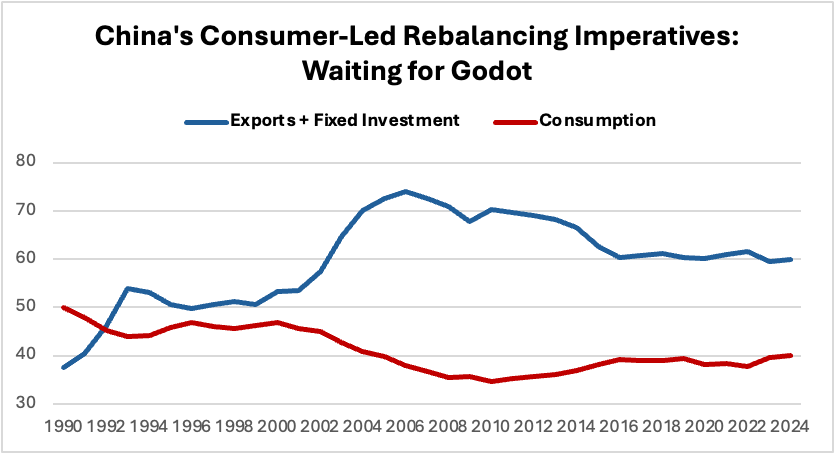
Source: National Bureau of Statistics (China) and World Bank Development Indicators
While the handwriting had been on the wall for this outcome since the so-called Fourth Plenum Party meeting of last October pointed to a “doubling down” of the focus of the now completed 14th Five Year Plan, I was hoping for some last-minute fine tuning. Since the famous “Four Uns” critique of former Premier Wen Jiabao in 2007, there has been a seemingly endless debate about the hows and whys of consumer-led rebalancing. I have long been in the camp that it hinged mainly on social safety net reform (especially health care and pensions) to reduce the considerable excesses of fear-driven precautionary saving. Others, like my good friend Martin Wolf of the Financial Times, argued that it was more of an income distribution problem that required an increase in the household share of national income. Chinese policymakers were in an altogether different camp, arguing that they could bring forward future consumption by offering increasingly generous trade-in allowances for cars, appliances, and other consumer durables; they emphasized that dubious point once again in the just-enacted new plan.
Endless debates have an uncanny way of staying endless, So late last year, I threw in the towel as an advocate for one approach over the others. I conceded to my Chinese friends that it is entirely your choice as to how to best stimulate your consumer sector. In the end, all I really cared about was results — namely, boosting the household consumption share of GDP. I put a target and a date on what I argued was a reasonable objective — a 50% share by 2035, up ten percentage point from the current unacceptably low portion of 40%. I wrote about the feasibility and the simple math of hitting that target, as illustrated in the chart in the below.
I concluded that I was now less interested in how to get there and more interested in how an explicit target allows the government to send an important message of discipline and resolve that would be required to shift China’s economic structure to achieve such an outcome. I added that target-setting macro-planners have had a good track record in managing the Chinese economy over the past several decades. It was time to draw on the record as a demonstration of the government’s determined commitment to the imperatives of consumer-led rebalancing. The outcome of the policy debate, I stressed, would be shaped by that explicit commitment.
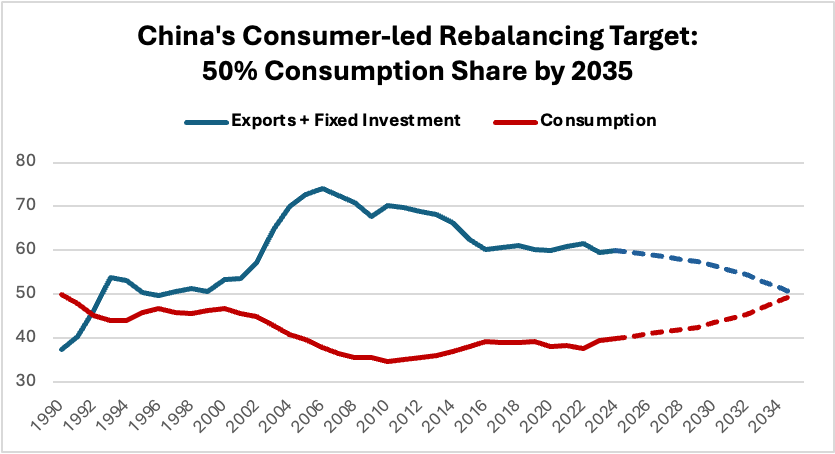
Source: National Bureau of Statistics (China); extrapolations from 2025-35 by author
That was not to be, at least not in the 15th Five-Year Plan. With the benefit of hindsight, I still believe that there is a perfectly logical macroeconomic case for the long-awaited transition to a more balanced structure of what had become an increasingly unbalanced Chinese economy. If anything, that logic has strengthened with China’s traditional sources of economic growth facing increasingly stiff headwinds — especially, with crisis-torn aftershocks in the property sector, a downturn in private sector capex, and a likely protectionist pushback against a still high-flying export sector. Household consumption is, by far, the most logical candidate to fill that void.
Chinese consumer-led rebalancing imperatives have been so logical, in fact, that I framed a very popular course that I taught at Yale for 13 years, “The Next China,” around this key theme. For the 1,400 students who took that course over the years (2010-22), my sincere apologies for having misled you that Chinese rebalancing was close at hand. I still hold out hope that such a day will come … eventually.
Several years ago I’m pretty sure that I heard Xi use the word ‘bourgeois’ in relation to consumers’ spending.
That has stuck in my mind as a possible reason that he is not quite so keen on improving the economy through the consumer.
Just a thought…
https://igreaterchina.substack.com/p/the-real-signals-inside-chinas-new?utm_campaign=post-expanded-share&utm_medium=web