

As has been the case for most of China’s recent plans, the 15th Five-Year Plan has a little bit of something for everyone. It is pro-innovation, pro-consumption, pro-manufacturing, and pro-services. It is aimed at supporting environmental protection, improved health, green technologies, and eco-friendly urbanization. It supports a China-centric transformation of global governance, and, of course, it contains countless references to Xi Jinping as the core leader, the architect of China’s guiding ideology of Xi Jinping Thought.
The Premier’s Work Report, delivered on the first day of the “two sessions,” details the first-year installment of what can be expected over the upcoming five-year planning horizon (2026-30). I have read all of these reports over the past thirty years. While they hardly make for scintillating reading, China watchers pour through these documents looking for hints of new developments in the economy or government policy. The growth target always gets the most attention. And we look for deep meaning in the ranking of the major items in work agenda for the upcoming year — domestic demand versus external support, science and technology versus rural revitalization, people’s well being versus risk mitigation, and so on.
My hope, as I have expressed countless times over the past two decades, is that China would finally get serious in promoting consumer-led rebalancing. The language in the overview of the 15th Five-year Plan that was contained in Premier Li Qiang’s March 5 work report was mildly encouraging in this regard. A strengthening of the domestic economy was listed as one of the top four strategic initiatives over the upcoming planning horizon — number two behind “high-quality development” — and there was a specific reference to “… realize a notable increase in household consumption as a share of GDP…”
Maybe I am guilty of making too much out of task rankings — it’s happened before — and in seeking deeper insight from the English language translation of Chinese rhetorical emphasis, but I am mildly encouraged for three reasons: First, China’s government reports rarely focus on household consumption; they typically emphasize a broader construct that includes government services provided to households. Second, government plans almost never emphasize the share of GDP as the denominator to gauge a household consumption target. Third, as traders used to say on Wall Street, “I am talking my own book.” Several times in the past year, I have come out strongly in favor of the need for China to adopt an explicit target of a 50% household consumption share for 2035 — a very low share by international standards but a ten-percentage point increase over the next decade relative to the current rock-bottom reading of around 40%. My point is that such a target, embedded in China’s credible planning record, would impose important strategic discipline on subsequent consumer-led initiatives in the years ahead.
The case for a broad consumption target purposefully ducks the contentious debate over which policy incentives are most likely to move the needle for Chinese households. I have long favored social safety reforms to reduce excess fear-driven precautionary saving. The government in recent years has preferred trade-in allowances for long-lived consumer durables — a measure that I feel mainly borrows from future consumption rather than boost the underlying growth in consumption. I must confess being a bit disappointed in the latest Work Report which appears to have once again placed greater emphasis on another round of trade-in subsidies (albeit a bit less so than last year), while proposing only a modest boost to livelihood support of rural pensions and medical benefits. But once again, I stress to my Chinese friends — it’s your economy, and your choice as to how to stimulate your consumers and reach the 50% consumption target by 2035..
In one sense, I concede the hint of a consumption target in the current work report may be wishful thinking. I checked the Premier’s work report, as well as the accompanying report of the National Development and Reform Commission (NDRC) very carefully and there was no explicit mention of a numerical target for the household consumption share. Reliable sources tell me, however, that additional numeric targets may well be added in the final report immediately after the “vote” on the Plan by the National People’s Congress; if so, that information would likely be available after the closing of the two sessions (March 12) and released by the NDRC the next day on March 13. So, on this key point, we will just have to wait and see.
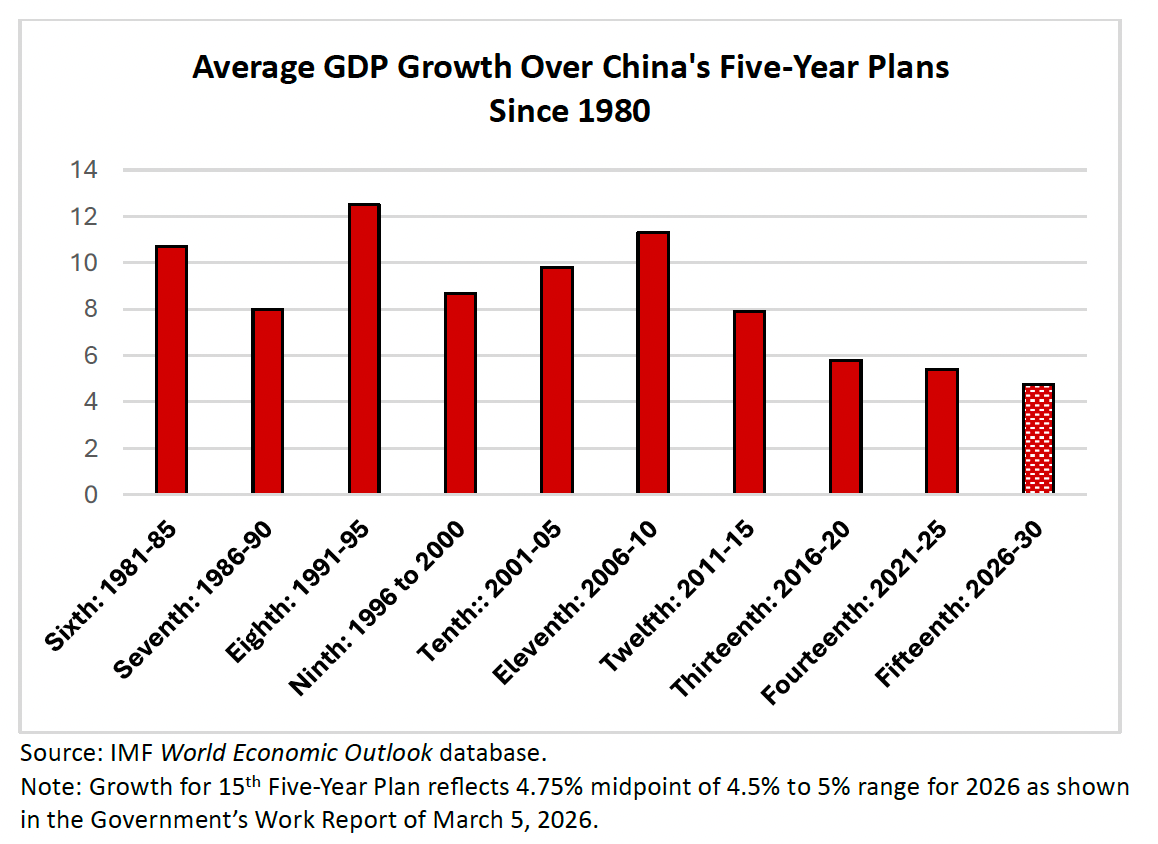
There is also an important analytical reason that may allow us to impute an implicit trajectory for a household consumption target over the five-year planning horizon. As has been widely conveyed, the Government has released a surprisingly weak overall GDP growth target for 2026 of 4.5% to 5%. Not only is this China’s weakest year-ahead official growth outlook since 1991, but, as the chart above shows, it is also likely to be the weakest growth for a five-year planning period since “reforms and opening up” began in the early 1980s.
But that may well be the point: consumer-led economies intrinsically grow slower than economies led by exports and investment. In the United States, for example — long the world’s quintessential consumer-led economy — real personal consumption has grown ,on average, 2.9% since 1980, well short of average growth in capex (4.3%) and exports (4.7%). If China wants to emulate American style consumer-led growth, slower GDP growth is probably in the cards for years to come. The seemingly weak 2026 target may well reflect that growing realization.
Normally, at this time of the year, I would be getting ready to head to China and discuss these issues at the annual China Development Forum That won’t be the case this year. I have been to the CDF for 25 years in a row, making me the longest attending foreign delegate at this important event. Apparently, my sources also tell me (a different source) that the organizers and senior leaders have become uncomfortable with my participation. Most likely, that’s because I have turned more cautious on prospects for the Chinese and Hong Kong economies. So much for candor!
The CDF was originally conceived by Premier Zhu Rongji in 2000 as a platform of engagement between senior Chinese officials and a group of international interlocutors that was brilliantly timed to occur immediately after the National People’s Congress. I felt privileged to be there at the inception. For many years, the CDF was rich in debate and had a strong culture of vigorous and open exchange. I fear that is no longer the case.
That your presence makes important people uncomfortable suggests Chinese leadership has become increasingly defensive and unwilling to hear the thoughts and opinions of accomplished professionals who have demonstrated they have no political axe to grind. This is a sad moment. Thank you for your work.
Very informative. I focus on technology and released the following article after the plan was formally endorsed. Thought you may be interested.
China's Five Year Plans are tremendously consequential and warrant far greater focus. https://preceperi.substack.com/p/new-focus-continuous-purpose