
China's Deepening Japan Problem
A Chinese capital-output ratio with Japanese characteristics

How many ways can you slice a pizza? That is the way I now feel about China’s rebalancing imperative. So many different metrics are now flashing the same conclusion — shares of GDP, the current account balance, aggregate domestic saving, youth unemployment, flirtations with deflation, income shares, the debt cycle, on and on. They all point to persistent imbalances in the Chinese economy and mounting risks of a Japanese-like endgame.
Yet the Chinese leadership continues to march on, fixated on a growth model that draws unsustainable support from innovation, new technologies, and other trappings of what they now call “new quality productive forces.” Xi Jinping is the champion of this approach, paying lip service to Chinese consumption but unwilling to take the big steps required of consumer-led rebalancing. He warns , for example, that aggressive social safety net reforms — health care and retirement — will backfire; the excesses of fear-driven precautionary saving might decline and boost discretionary consumer demand, goes the argument, but at the cost of raising the corrosive risks of a western-style welfare state. Egad, who wants that?
Let me try a different angle that proved very accurate in foretelling the Japanese disease. Shown in the chart below are capital-output ratios for Japan and China. When the ratio rises, the economy experiences what economists call “capital deepening” — meaning that it takes ever larger increments of its capital stock to generate a unit of output (GDP). This, of course, is associated with progressively lower returns on the capital stock that presumably would set a self-corrective process in motion that would lead to a reduction of capital-intensive economic growth.
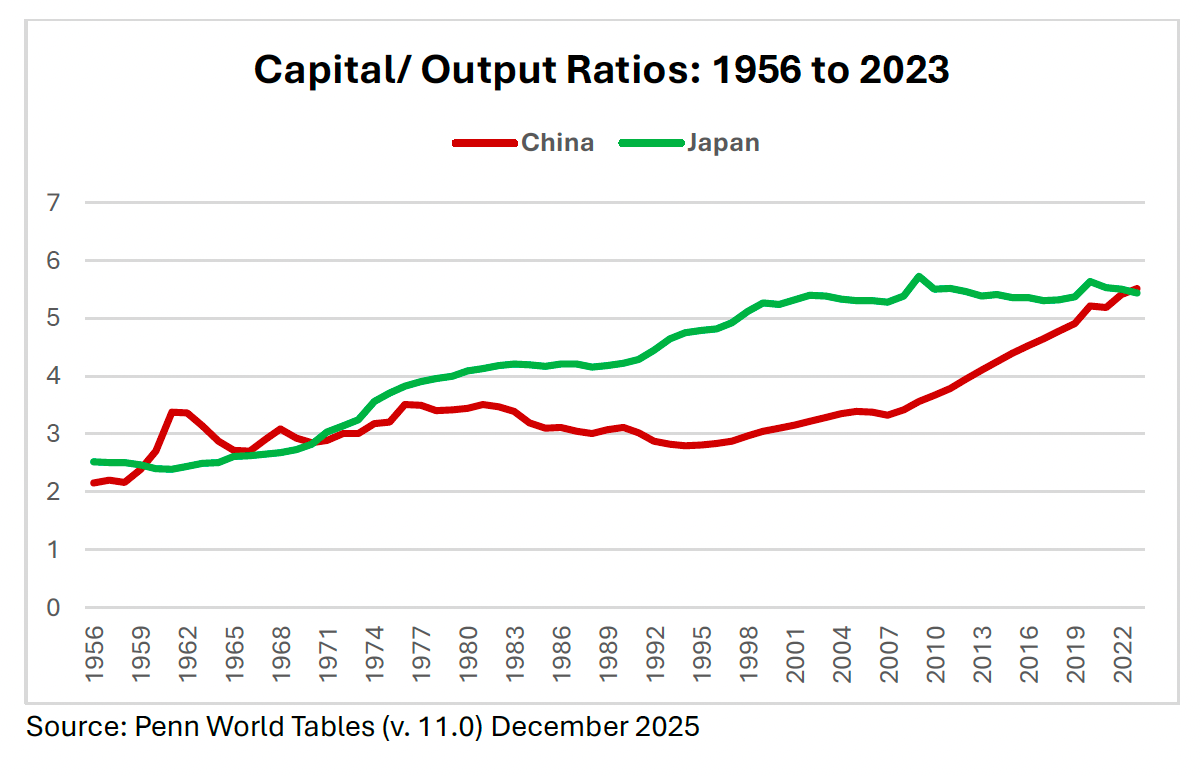
That was not the case for Japan in its first lost decade, when the capital-output ratio (shown in the green line) increased sharply by 24% from 1990 to 2000. As the stock market surged, Corporate Japan became convinced that capital deepening was the recipe for higher returns to shareholders. The bet ignored the bursting of the Japanese equity bubble in the early 1990s. Like all stock market implosions, denial was powerful in the early post-bubble period and investment-led capital deepening continued. For Fumio Hayashi and Edward Prescott, two of the earliest scholars of the Japanese disease, this was a powerful signal of the coming stagnation in the Japanese real economy; with one lost decade eventually turning into three, that forecast was very much on the mark.
By comparison, a more recent strain of Chinese capital deepening is very disturbing. From 2008 to 2023 (last data point available in the Penn World Tables), China’s capital-output ratio soared by 62% — over two and a half times the 24% increase in Japan during the 1990s. Moreover, by the end of this fifteen-year period, the Chinese ratio had basically converged on its Japanese counterpart. Unlike Japan where capital deepening continued in the face of post-bubble carnage in its equity market, China’s capital deepening took place in a more volatile equity market climate — three sharp run-ups in 2014-15, 2019-21, and again in 2024-26. Chinese capital deepening was driven less by the attraction of equity returns and more by the strong guidance of its leader, Xi Jinping, and his steadfast fixation on new quality productive forces.
(As an aside, I would venture the guess that China’s capital deepening has intensified in recent years beyond the period covered by the chart above (which ends in 2023). That’s because the AI-related data center construction frenzy is raising the capital stock at a time when Chinese GDP growth is slipping further, falling recently below its 4.5% to 5% target for 2026.)
There is a great read by Evan Osnos in the August 3 issue of The New Yorker that speaks to China’s glorious technology-led future if it stays its recent course. Entitled “The Future, Made in China,” his latest piece is loaded with anecdotal tales of wonder about China’s robots, “dark” (i.e., completely automated) factories, high-speed EVs, and everything you want to know about AI. Osnos is a wonderful writer in The New Yorker tradition, but I was left wondering if he hasn’t taken some of the CCP’s bait too far — hook, line, and sinker.
The subtext of this article is America’s looming competitive battle with a rising superpower, a topic I have also addressed repeatedly in my own work. Like Osnos, I worry about this a good deal, but less so if China stays its course and more if the US falls into a MAGA sinkhole dominated by underinvestment in basic research and higher education, along with an arrogant disdain for expert advice. In another sense, I have to confess that the Osmos piece has a familiar ring in similar tales we heard about the Japanese techno miracle in the late 1980s — books and articles by Sony founder Akio Morita, Ezra Vogel, and Clyde Prestowitz. It’s not that they under-estimated America — they all missed what was to befall Japan.
Michael Pettis and I are kindred spirits in this debate. We have both focused for years on the imperatives of Chinese rebalancing. Our frameworks are a little different, but our bottom-line conclusions are very much the same. We agree on Japan where the problem was not so much its technological successes but the sustainability of its growth model. We both share the view that the same lesson might be very much be applicable to China. My point on capital deepening is offered in that same spirit — the sustainability of the Chinese growth model, which is now showing unmistakble signs of sputtering.
China, by population, is larger than Japan by ten times. So not sure how appropriate to compare the two economies. Similarly, China is larger than the US by nearly four times. So not quite fair to expect a fair competition.
I agree that China faces some genuinely Japan-like risks, especially weak domestic demand, demographics, balance-sheet adjustment and declining returns on parts of the capital stock even with the expansion of the new technology sectors. But I am less convinced that the capital-output ratio itself tells us very much about the eventual outcome.
Strictly speaking, capital deepening refers to rising capital per worker, K/L, while the chart here measures K/Y. A rising K/Y means declining average capital productivity, which is certainly worth watching, but it does not by itself imply Japan-style stagnation. South Korea’s capital-output ratio also rose to roughly 5.1 by 2023, close to Japan and China, without producing three lost decades.
The more important comparison, in my view, is therefore China and Japan’s productivity regimes, not simply their capital-output ratios. Japan entered the 1990s already rich, highly urbanized and close to the technological frontier. China still has substantial catch-up potential in services, automation, regional productivity and capital allocation.
So the key question is whether China’s current investment in AI, robotics, electrification and advanced manufacturing merely adds more low-return capital, or whether it eventually raises economy-wide TFP. That distinction will tell us far more about China’s “Japan problem” than K/Y alone.