
Wag the Dog
The relevance of a 1997 film?

In December 1997, Janet Maslin wrote a great film review of “Wag the Dog” in The York Times, the highlights of which are shown in what follows:
“Probably there are people who believe that President Clinton has actually adopted a chocolate Labrador retriever puppy named Buddy. But these are not people who have had the great fun of watching “Wag the Dog,” the poison-tipped political satire that’s as scarily plausible as it is swift, hilarious and impossible to resist.
Splendidly acted, … “Wag the Dog” makes it impossible to trust any image-enhancing gesture that attracts national media attention. Particularly any gesture involving a cute pet.
This is a movie, after all, in which political consultants film a bag of Tostitos and then digitally turn it into a kitten. It’s no small measure of the film’s sneakiness to say that this is almost the least of its dirty tricks.
To say that the priceless Tostito maneuver is staged cynically is to underestimate both the film’s terrifically astute humor and its high spirits, which prevail despite the essential awfulness of what is being seen. “Wag the Dog” takes the stance that American public policy may be founded on fraud in high places, and that there is no public outpouring too spontaneous looking to be manipulated by political puppeteers.
“Wag the Dog” essentially amounts to a huge inside joke. It’s possible that viewers indifferent to political and media chicanery will miss some of the barbs here, but those same gags will fill savvier audiences with wicked glee.
With its comic sensibility solidly grounded at the place (a very tiny one) where political and media scruples meet, the film imagines a president with a problem. Eleven days before an election, a pass made at a young female scout is threatening to make headlines, and the opposition candidate is running commercials to the tune of “Thank Heaven for Little Girls.” What to do? Call in the consultants. Have them start a war.
“Why Albania?” Winifred [the blonde presidential assistant] asks him. “Why not?” replies Conrad [the consultant].
As Conrad explains, the best wars these days are those with show-business connections. Which is to say that one perfect picture of a smart bomb falling down an Iraqi chimney (or a napalmed Vietnamese girl or a flag planted in Iwo Jima) may be all it takes to capture the nation’s imagination.
Thus, the film travels to the palatial California digs of Stanley Motss, a movie producer who has all the right image-making skills and overweening narcissism for this job. Stanley is the sort who is first seen inside his tanning machine, ordering his manservant to bring him a veggie shake, and who casually appraises the Presidential furniture when he visits the Oval Office. The film knows its Hollywood royalty all too well.
Stanley conducts business meetings in tennis clothes or in robe and slippers. He turns peevish when a call from the president interrupts one of his show-biz anecdotes. He treats the world of politics with perfect casualness, especially when offered an ambassadorship in reward for his efforts. “Ambassador to what?” Stanley asks in disbelief. “I don’t even like going to Brentwood.”
“Wag the Dog” watches mirthfully as Stanley gets mobilized, brings in his troops. Among the many high points of the campaign are the filming of a bogus Albanian battle scene for the evening news, the recording of a “We Are The World”-type inspirational song, and the faking of an old folk song.
This guy proves to be something different from what the spin doctors ordered. The best that can be said for him is “He’s fine as long as he gets his medication.”
“What did television ever do to you?” Conrad angrily asks Winifred late in the story. “It destroyed the electoral process!” Winifred screams. Watch “Wag the Dog” and see how it’s done.
“Wag the Dog” is rated R. It includes mild profanity at well-chosen moments.”
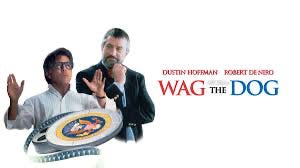
The 1997 film, starring Dustin Hoffman and Robert De Niro, was great political satire. But unlike today’s war in Iran, it was staged around a fictious war in Albania to deflect public opinion away from a pre-election sex scandal embroiling an incumbent president. It was a tale of media manipulation of a gullible American public.
While it didn’t win any major awards (other than a special prize at the Berlin International Film Festival) the film has had an enduring impact on US political discourse. The “tail” in the movie was a fake war in Albania while the “dog” was the political threat of a presidential sex scandal. When the tail wags, the dog all but disappears.
The timing of the film was impeccable. In August 1998, President Bill Clinton, who was then ensnared in the Lewinsky sex scandal, launched missile strikes at Al-Queda training camps in Afghanistan. ‘Wag the Dog” fit all too easily into America’s cynical politics.
Today’s tail is far from fiction, as missiles fall throughout the Middle East and a US president seeks regime change in the world’s greatest sponsor of terrorism. But, here as well, the timing is impeccable in that this war fits the script of the film reasonably well. Public opinion of the Trump Administration has all but collapsed and the President, himself, is now facing accusations over the heinous Epstein sex crimes. I am sure it is just a coincidence, but Donald Trump (the dog) has plenty to deflect, and a “massive bombing campaign” aimed at Iran certainly qualifies as a very prominent tail.
Personal confession: I grew up near Hollywood, so I have always been enthralled by the messages in political films. Watch it on Apple TV and see for yourself.
You mean Operation Epstein Distraction?
I started watching Trump’s press conference today. It was shockingly incoherent, even for him.
No clear mission, no imminent threat, no military plan, no post regime plan. In fact he said earlier that the people they thought could take over Iran were killed in the strike!
WTF??? You killed the current AND the planned regime?
And then, amazingly, without missing a beat he pivoted to a long exposition on the ballroom!! The F’ing ballroom!!! Went on and on.
And the event was a Medal of Honor ceremony!!
And is any of this a surprise? NO! So anyone who voted for Trump is seriously out of touch with reality.
Simply beyond belief.