
Trump's Red Line Inflation Problem
Something he has in common with Xi Jinping

Recently, I was critical of Chinese President Xi Jinping for a flaw in his foreign policy stance. I argued that he was guilty of “red line inflation” — framing multiple non-negotiable positions that conflate Chinese determination with the clarity of priority signaling. In his recent summit with US President Donald Trump in Beijing, Xi injected an added troublesome dimension to this problem by turning the Taiwan red line into an outright threat leveled at the US.
What does this mean for China’s other red lines that Xi insists the US must respect — control over its other territories (like Xinjiang, Hong Kong, and Tibet) , the ruling monopoly of the Chinese Communist Party, and its right to development by resisting any US containment efforts? By sharpening the Taiwan red line, is Xi effectively diminishing importance of the others? At a minimum, this is a very confusing message to send. More worrisome for China is that this approach may well undermine Xi’s his multiple red-line negotiating strategy with the US.
Ever the tough dealmaker, Donald Trump appears to have a congenital problem with red-line inflation. The red-line bluffs of TACO are one thing as I pointed out in my criticism if XI Jinping’s approach, but Trump’s multiple non-negotiable positions on Iran are another matter altogether. As of this writing, the President is insisting that Iran should have no nuclear weapons capability and that it must re-open the Strait of Hormuz. And he bounces back and forth between a third red line — that the US must oversee the removal of Iran’s stockpile of enriched uranium and/or that Iran must remove all mines in the Strait of Hormuz within 30 days.
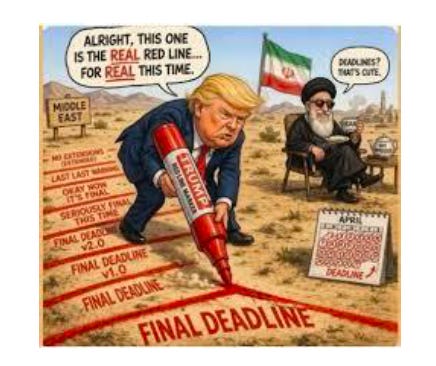
And now, just as Xi did with Taiwan at the Beijing summit, Trump is singling out one red line over the others — that Iran must ever forswear its desire to possess nuclear weapons. Ironically, in the most widely telegraphed ceasefire negotiations in history, this looks like the one US demand that is not likely to be met in the current round of negotiations. The problem with red line inflation, as I pointed out in my criticism of China, is that it can lead to a destabilizing false hierarchy of demands. Iran seems like to respect some combination of Trump’s second and third most important red lines — but not his number one insistence on nuclear weapons capability, at least not now.
Game theorists have a field day with the concept of multiple non-negotiable red lines. Thomas Schelling’s Nobel-prize winning contribution to the strategy of conflict argues that the power of the red line comes from its credibility. In a multiple red line scenario, if your adversary forces you to back down one position, then your reputation suffers as a tough adherent to your other so-called non-negotiable positions. It follows that the more red lines you insist upon, the less each one signals. From TACO to Iran, the dealmaker US president is utterly clueless about strategy.
Trump is utterly clueless about everything other than a carnival barker's ability to yell and get people to pay attention to him. If one reviews his actual business history, it is a string of bankruptcies, lawsuits, and general failures. He was essentially tanked, when the TV show...which he didn't think of or produce...breathed new life into his miserable personage. Even the ghost author of his book "Art Of The Deal" has stated it's all inflated baloney and he wishes he'd never got involved.
The power of TV and media to negatively influence politics, as described by Neil Postman in the 1980's with his book "Amusing Ourselves To Death", is playing out IRL.
Neil Postman argued that modern media—especially television—had transformed serious public discourse into entertainment. His central idea was not simply that television showed too much entertainment, but that the form of television made politics, news, religion, and education increasingly resemble show business.
And here we are.
What I admire about Stephen Roach is that even though I do not always agree with him, I never doubt the seriousness of his convictions. In this case, regarding Trump, I agree with him entirely. In a public sphere crowded with career-safe commentary and hedged institutional language, Roach still writes with moral and intellectual clarity. His criticism of American strategic incoherence therefore carries the force of a public intellectual who has retained something increasingly rare: integrity.