
The USTR Strikes Again
The US Trade Representative is following the same discredited script it used in 2018 to justify another round of Trump tariffs.

The Office of the United States Trade Representative (USTR) has borrowed a page from the losing trade war of 2018-19. Under orders from the President, it has issued a lengthy Section 301 investigation report that purports to provide a legal rationale for the imposition of yet another round on US tariffs. Like the USTR’s earlier attempt to do this with a 182- page report in 2018, the latest effort, coming in at a mere 79 pages (with 13 pages of appendicles), will backfire. Here’s why.
First of all, it is important to keep in mind that the USTR is no longer the serious independent negotiating authority that it used to be. Its origins date back to the early 1960s when President Kennedy concluded that the State Department was no longer best suited to conduct trade negotiations. An early version of the USTR, the Office of the Special Trade Representative (STR), took over US negotiations in what became known as the Kennedy Round of multilateral trade negotiations (1964-67). It was renamed the USTR in 1979, and under the leadership of Carla Hills successfully led US negotiations for the Uruguay Round (1986-94). Both the STR and its successor, USTR, have always been organizationally situated in the Executive Office of the President. Under President Trump, with his long-standing disdain for trade deals of almost any sort, the USTR has been repeatedly tasked with doing his bidding in waging losing battles with America’s trading partners.
An hint of the shifting role of the USTR from negotiator to combatant was evident in the trade skirmishes with Japan in the early 1980s. During that period, a young Deputy Representative of the USTR by the name of Robert Lighthizer discovered that Section 301 of the Trade Act of 1974 could be invoked to put pressure on Japan for alleged unfair trading practices. Trained as a lawyer, with no understanding of the macroeconomic context of trade issues, it was Lighthizer’s first attempt to try and address America’s gaping trade deficit by hopelessly focusing on the largest bilateral piece of a multilateral imbalance. When he was promoted to head of the USTR during the first Trump Administration, he took the same failed approach with China. Unsurprisingly, while the Chinese imbalance got smaller, the overall trade deficit widened: the total US trade deficit in goods went from $792 billion in 2017 to $901 billion in 2020 (and in 2025 hit $1230 billion).
Jamieson Greer, the current USTR, is cut from the same cloth — a trade lawyer that doesn’t do macro. He had the unfortunate experience of studying under Robert Lighthizer as his chief of staff during Trump 1.0, and was credited with playing a major role in the so-called Phase I trade negotiations with China, another failed deal. And now he is at again, playing the Section 301 angle to counter the Supreme Court’s recent ruling to strike the so-called Liberation Day tariffs that Trump rolled out on April 2, 2025, as an emergency remedy to America’s gaping multilateral trade deficit. When SCOTUS ruled that there was “no there, there” (i.e., no emergency under so-called IEEPA provisions), Trump Administration officials, including the USTR, smugly warned of a “more legal” end-around. The USTR report of June 2, followed by proposed actions of new 10% to 12.5% tariffs on 60 of America’s trading partners, purportedly delivers on that promise.
Don’t kid yourself. Greer’s legal strategy is just as deficient as the one concocted by Lighthizer in 2018 to address America’s China problem. In 2018, it was unsubstantiated allegations of forced technology transfer, intellectual property theft, cyberhacking, and so-called predatory acquisitions by outbound Chinese scavengers. In 2026, it is allegations of worldwide abuses of forced labor that the USTR claims to qualify as a legitimate Section 301 complaint.
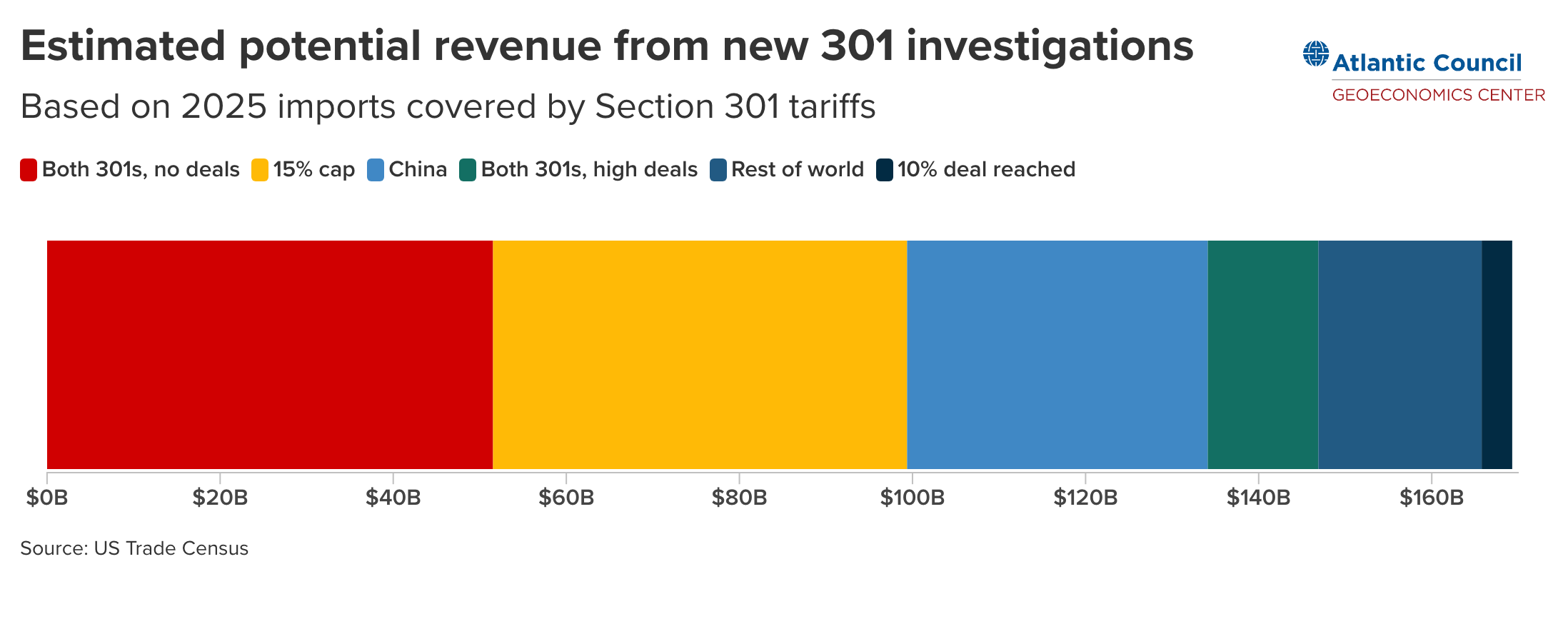
On one count, the USTR has gone a bit further in 2026 than it did in 2018. This time, the allegations are closer to being multilateral in scope, covering some 60 countries that allegedly engage in forced labor practices (54 of the 60), or do not enforce the forced labor restrictions they have on the books (6 of the 60). And this time there is an effort to marshal some semblance of macro evidence in support of those charges, namely statistics from the International Labor Organization that attempt to decompose worldwide forced labor trends unto state-imposed efforts and those in the private economy. But, as the chart above hints, the USTR doesn’t go into the weeds in making the case that its new Section 301 tariffs will replace those that were illegally imposed under IEEPA. Nor does it address the seemingly technical “burden-of-proof” issues pertaining to forced labor that may fall on importers (the US) or on foreign governments (Europe).
Moreover, to compensate for the paucity of micro, or product-specific, data in support these charges, the USTR presents three detailed case studies where US exporters have supposedly been damaged by unfair competition from foreign goods produced by forced labor — tobacco from Malawi, rice from Burma, and frozen beef from Brazil. In all these cases, the USTR notes that information on the role of “forced labor is limited due, in part, to its illicit nature.” It takes a similar tack in accusing China of forced labor transgression in polysilicon (i.e., solar cells) and cotton, problems they claim are exacerbated by supply-chain linkages and transshipments from other nations that are being accused of violating forced labor standards.
The June 2026 USTR report concludes with a country-by country assessment of forced labor practices and the impact that such actions may have on burdening or restricting US commerce. Unsurprisingly, all 60 countries are found guilty as charged. The USTR makes especially dubious and highly provocative cases against Europe and Canada. Yet in no instance is any hard evidence offered to support these conclusions; the closest the USTR comes to that is in Appendix C which provides “yes” or “no” subjective answers of forced labor impacts on a country-by-country basis for selected US imports of aluminum, cotton, cocoa, fish, coffee, nickel, palm oil, peanuts, polysilicon, rice, and tobacco. Like the 2018 USTR report, the 2026 effort mistakes anecdotal evidence for evidentiary confirmation of its sweeping charges. Written by lawyers, both reports are loaded with innumerable footnotes (1,139 in 2018 and 217 footnotes in 2026) to impress readers by seemingly authenticating these charges. But don’t mistake legalese for veracity. The smoking gun of competitive damage to the US doesn’t have any bullets.
Forced labor practices are a sad testimony to the horrific abuses faced by the poor in many parts of the world. Yet are they really all that different from the extremely tough conditions faced by the some 8 to 10 million illegal workers in the United States? Not only is the pot close to calling the kettle black, but the USTR appears to be continuing in the fine recent tradition of concocting yet another pretext for Trump’s illegal tariffs. It didn’t work before and seems highly unlikely to work this time.
Section 301 begins as a legal lasso aimed at foreign suppliers, but becomes a legal noose around America’s own replenishment system. Each tariff meant to punish alleged coercion raises the cost, delay and uncertainty of the inputs American factories need to compete. Under Mearsheimer’s Offensive Realism framework, forward deployment to prevent rival regional hegemony already raises the cost of multi-theatre deterrence. Section 301 then compounds that burden by increasing input costs, supply-chain friction, interest-rate pressure and the price of the material requisites needed to sustain security-dilemma logic. Koch’s Law of Detainment explains the result: America does not merely confront external constraints; it accelerates relative decline by legally detaining the very requisites required to sustain its own grand strategy.