
SCOTUS Shoots Straight on Tariffs
Economics and the rule of law in close alignment

The US Supreme Court did the right thing. Admitting that it had, “… no special competence in matters of economics and foreign affairs,” the Court stayed in its lane, as dictated by Article III of the US Constitution, and ruled solely on the legality of President Trump’s signature tariff policies. Its February 20 verdict that IEEPA (the International Emergency Economic Powers Act of 1977), “… does not authorize the President to impose tariffs …” makes great sense.
The Court’s basic argument is that the separation of powers under the US Constitution grants taxing authority solely to the Congress. The corollary: Yes, notwithstanding the absurd protestations of the Trump Administration, tariffs are, indeed, taxes on American companies and people. SCOTUS finally stood up to Trump’s audacious overreach of executive power; as Chief Justice Roberts wrote in the principal majority opinion, the Court was not about to allow such a “transformative expansion of the President’s authority over tariff policy.”
Turnabout is fair play. Having no special competence in legal matters — except having a small office at Yale Law School — I will leave it to the lawyers to dissect the legalese of this ruling. I choose, instead, to weigh in on the economic implications of this important decision. As I see it, the legal basis underpinning the tariff decision is well aligned with the economics of the verdict for three key reasons:
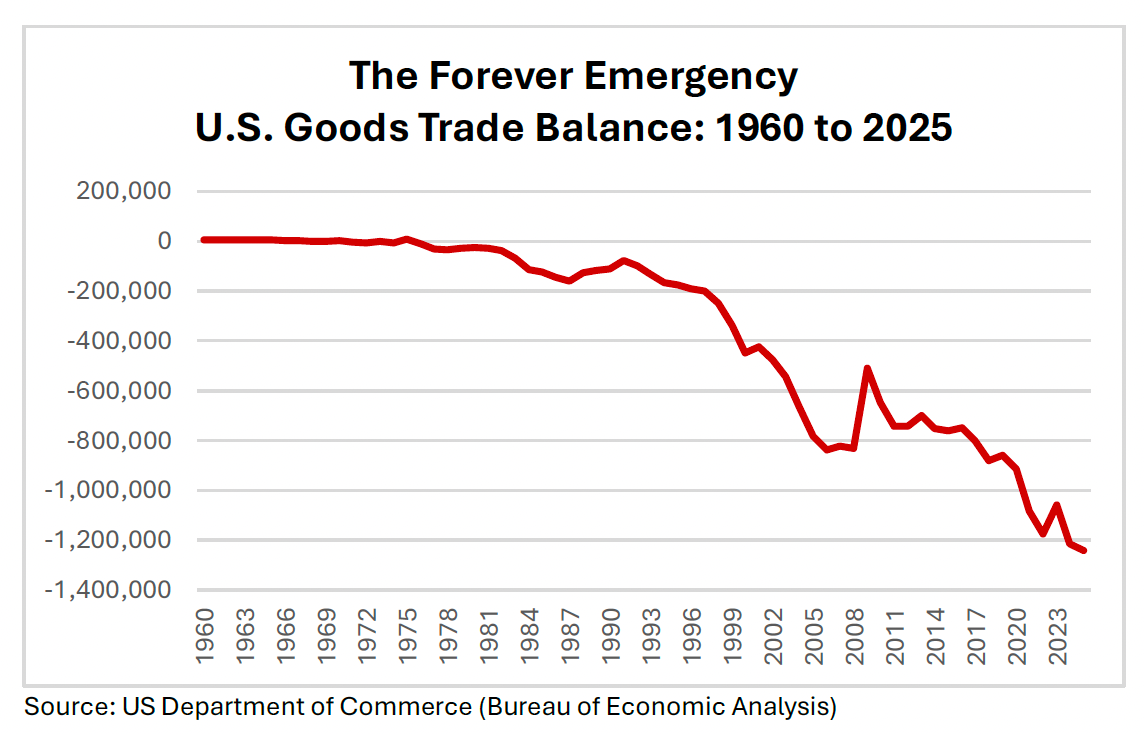
First, trade deficits are not the emergency that Trump claimed in invoking IEEPA as the justification for his inappropriate use of the tariff cudgel. We have had trade deficits in manufactured goods every year since 1976 (see chart below). Last year, despite the sharp increase in Trump’s now-illegal tariffs, the US trade deficit in goods hit a new record of $1.2 trillion, up 2% from the prior record in 2024.
The real emergency is America’s extraordinary lack of saving. The net domestic saving rate — the sum of depreciation-adjusted saving of US businesses, households, and the government sector — fell to an estimated 0.2% of national income in 2025. Lacking the domestic saving needed to fund economic growth, America must import foreign surplus saving from abroad and run outsize balance-of-payments and trade deficits to attract the foreign capital. Thanks to reckless US fiscal policy, on track for massive federal budget deficits over the next decade, an anemic saving trajectory promises huge trade deficits for years to come.
Second, tariffs hurt. Far from the “most beautiful word in the dictionary,” as Donald Trump has repeatedly claimed, tariffs are not paid by foreign countries — they are duties (i.e., taxes) paid by importers for goods upon arrival in the United States. The principal dissent to the majority SCOTUS opinion, written by Associate Justice Brett Kavanaugh, claims that “Congress ordinarily seeks to give the President substantial authority and flexibility to protect America and the American people.” If so, Trump’s tariffs have done the opposite. A recent Federal Reserve study found that more than 90% of the tariff tax has been passed on to American consumers in the form of higher prices.
While this research was unfairly trashed by Kevin Hassett, Chairman of the President’s Council of Economic Advisors, that is more of a sad commentary on Hassett’s sycophantic character, a trait that he unfortunately shares with other senior members of Trump’s economics team, Secretaries Bessent (Treasury) and Lutnick (Commerce). This latest Fed study, by the way, agrees with most of the other serious research that has been undertaken to assess the impacts of Trump’s tariffs.
Lastly, there are important global implications to consider. Not only is Donald Trump highly critical of globalization and those he mockingly calls the globalists who support a rules-based world trading system, but his America First mantra has taken dead aim on the alliances that have long proved so beneficial to the United States. It’s not just Europe and NATO that that have been subjected to his tirades — this year’s Davos speech only being the latest such rant — but he is also threatening to unwind the USMCA trade agreement with Canada and Mexico that he once claimed was the crown jewel of his first administration.
Like SCOTUS, I will stay in my lane and, in this case, stick with economics. Fully 54% of total US trade flows (exports and imports, combined) in manufactured products are with Europe, Canada, and Mexico. We trade with these nations because we must, not because the globalists have a secret plot to undermine America. As noted above, we need foreign capital to grow and the price we pay for that shows up in terms of cross-border trade, including the powerful efficiencies of global supply chains.
Trump’s tariffs have been a shock to the world trading system. While they have shifted the mix of our trade deficits away from highly tariffed nations line China, they have not reduced the overall trade deficit that weighs on US manufacturers and workers. Unwinding America’s linkages with Europe, Mexico and Canada would only divert their trade flows elsewhere and reduce the efficiency and security dividends that have long benefited America. Predictably, in a fit of anger, the President has upped the ante on his counter to the ruling, citing “a thorough, detailed, and complete review” of the SCOTUS ruling as justification for imposing a a new temporary global tariff of 10% that he has subsequently raised to 15%. Any guess on when that review might be available?
The US Supreme Court spoke of none of the above in their 170 pages of opinions. Nor did the Court make any attempt to assess the validity of the so-called emergency required of an IEEPA action. Still, the narrow finding, that IEEPA-based tariffs are unconstitutional sends an important message to the American body politic, and for that matter, to the rest of the world: US policies must be value-based, not personalized by the vindictive and uniformed whims of a wannabe autocrat. SCOTUS drove that point home by standing up for the rule of law.
In the end, Chief Justice John Roberts put it best: “What common sense suggests, congressional practice confirms.” No, we don’t have a supreme court in economics. But the time will come when the US economy and financial markets will render a verdict of their own.
1) “the bleeding”? What on earth are you talking about? I have the freedom to buy what I want. If a US manufacturer cannot make what I want or if it’s too expensive I have the right to buy it from wherever it’s made. No “bleeding”, just economic freedom and consumer choice.
2) The current annualized inflation rate is 2.7% not 2.2%.
The price index for gross domestic purchases increased 3.7 percent in the fourth quarter, compared with an increase of 3.4 percent in the third quarter. The personal consumption expenditures (PCE) price index increased 2.9 percent
~ Department of Commerce
3) not to quibble but the trade deficit with China fell 32% not 40%. However the the US goods trade deficit is WORSE, it WIDENED, just the countries changed. Mexico, Canada and EU are the largest components. Our soybean farmers were crushed for nothing and are now “welfare farmers” because we have to bail them out for $12 billion.
4) no one knows what “ Quasi-national cartels under state capitalism” even means.
5) and let’s be clear tariffs are import TAXES imposed on Americans NOT foreign governments. No Taxation Without Representation means you go through Congress and not the whim of a convicted felon. Trump knowingly lies to the public saying foreign governments pay.
6) There is no national emergency‼️ Import taxes are a scam to try and justify tax cuts for those who don’t need them. These tax cuts and Ice funding should be repealed.
7) The economy is slowing.
Real GDP increased 2.2 percent in 2025 (from the 2024 annual level to the 2025 annual level), compared with an increase of 2.8 percent in 2024.
~ Department of Commerce
8) Employment has slowed dramatically
Based on February 2026 revisions, U.S. employment growth experienced a sharp slowdown, with job gains falling to 1.5 million in 2024 (down from 2 million) and a modest 181,000 in 2025. Monthly gains dropped to roughly 15,000 in 2025—the slowest non-recessionary growth since 2003—down from an average of 122,000 in 2024
~ Wall Street Journal
9) The budget deficit for 2025 was $1.8 TRILLION, the third highest on record. These tax cuts other two were also Trump related. He’s added about $10 trillion to our national debt or 25%. The most in history. He is driving the US into a massive financial crisis.
Look at how the US under Trump has totally walked, no run, away from Ukraine in order to orchestrate a win by Putin. Why? Because Donald J Trump is a traitor to the USA and is aligned more closely with Putin’s Russia than with America. How in gods name can any American allow this to continue.
https://share.icloud.com/photos/071fP9NDrhHCNXmB6TCDWRy4w