

Intervening in huge financial markets is a fool’s game. Those who try are usually incapable of learning that tough lesson. So it is with Scott Bessent, America’s 79th Secretary of the Treasury as he takes aim on currency and bond markets.
Bessent doesn’t think these markets are providing a ”fair” signal of their underlying fundamentals — that long-term US interest rates should be lower, the yen should be stronger, and by inference, the dollar weaker. Accordingly, in partnership with Japan’s Ministry of Finance, he committed the US Treasury to between $5 and $10 billion in support of a long weakening Japanese yen, while Japan has chipped with small change of another $53 billion. A few weeks later, the treasury secretary announced an increased buyback of long-dated US Treasury securities that works out to about $32 billion per quarter.
These are puny numbers relative to the vast size of both markets. The foreign exchange market is the largest and most liquid financial market in the world. In 2025, global FX turnover averaged about $9.5 trillion per day. By contrast, in the $31.5 trillion US Treasury market, the largest individual security market in the world, daily trading volume currently averages about $1.2 trillion, or 13% of that in FX markets.
The yen support move of the US and Japan, combined, works out to about to about 0.6% of total daily FX turnover (or nearly 4% of daily yen trading) while the Treasury support action is equivalent to only about 0.1% of the market per quarter. Bessent has suggested that the Treasury buyback initiative could be expanded and there is a related possibility of additional joint yen intervention as well. Either way, these actions are tiny, at best, a signaling mechanism of more market intervention to come.
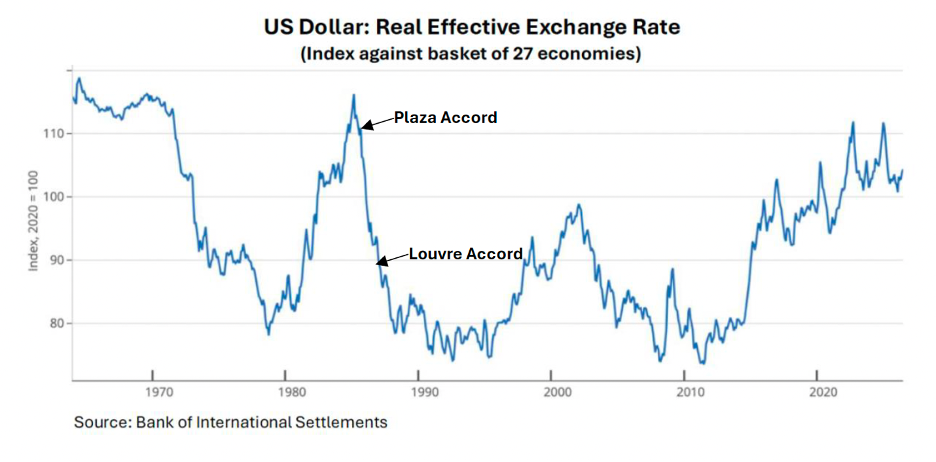
There is a myth that coordinated currency intervention was decisive in the 1980s in addressing the extremes of US dollar valuations — too strong in the mid-1980s and too weak a few years later. It turns out that that the Plaza Accord, aimed at weakening an overvalued US dollar, came in September 1985, fully seven months after the dollar peaked in February of that year. A different result followed the joint intervention of the Louvre Accord in February 1987 that was aimed at stabilizing international currency markets after the dollar’s subsequent plunge of 1985-86; this intervention came about a year and half before the dollar started bottoming in 1989-90. (BIS data on the dollar’s real effective exchange rate against a basket of 27 major economies.)
In other words, the joint currency intervention of major industrial powers does not match up well with major shifts in global FX markets. The Plaza Accord piled on to a trend that was already unfolding and the Louvre Accord struggled to have any impact. Significantly, these joint actions did not break the back of currency speculators, as George Soros famously did in betting against the British pound in 1992. Bessent, working for Soros at the time, and part of the team planning that famous attack on sterling, may be guilty of conflating today’s circumstances with those he was involved with nearly 34 years ago. Fond memories do not make for great forecasts all these years later. I can certainly attest to that myself!
The early returns in the currency and bond markets offer little encouragement that the latest interventions have made much of a difference. Any momentary blips at the time of the moves have subsequently been reversed. The yen continues to weaken and rates on long Treasures are back to where they were before the buyback announcement. Meanwhile, the dollar has weakened and gold prices — possibly, a new safe haven — have moved sharply higher. If Mario Draghi’s 2012 motto of doing “whatever it takes” to support a then beleaguered euro holds true this time, Bessent clearly has a lot more of the whatever to do. A lot more.
I first met Scott Bessent in the mid-1990s. For a few years, he was a regular attendee at Morgan Stanley’s fabled Lyford Cay investment conference. He moved on and so did I. We reconnected at Yale, and in 2011 he invited me to speak at a seminar on financial crises that he was teaching at one of the residential colleges.
He went on to bigger and better things, and I am still at Yale. No complaints but just a few observations: Back then, I was struck by Scott’s modest demeaner and humility. I don’t see that today in his current high-profile position as chief economist of the Trump Administration. A year ago, I raised questions about his new role as sycophant that bordered on mendacity in supporting many of President Trump’s most outrageous positions on the economy — tariffs, jobs, growth, and the integrity of the Yale Budget Lab and the US Bureau of Labor Statistics.
Bessent, the politician, took me back to the ancient Chinese tales of Zhao Gao, the most famous eunuch of the early Qin Dynasty (200 BC). According to legend, Zhao was a ruthless master of factual distortion in providing advice to the emperor of the time, Qin Er Shi. He even convinced the emperor and his court that a deer was a horse. In his attempts to manipulate markets, Treasury Secretary Bessent is most assuredly not a horse.
Right you are Mr. Roach, as Bessent is on a fool's errand. We all know how this will end. In reflecting upon your career your statement that "fond memories do not make for great forecasts" speaks to everything you have learned and your humility. Knowledge, experience, judgment and humility are what I value and why I pay attention to your thoughts. Thank you.
Stephen Roach at Yale (and Steve Hanke over at John Hopkins), both big time global elitists feted by the world for their currency advice, which is rooted in the nation-state system and ignores change. These are old guys, with old ideas. When Roach mentions Yale's budget its just edifies his entrenched elitism, Yale has the 2nd largest endowment behind Harvard, but they want middle class US taxpayers to subsidize them. When Roach started high fiving the Chinese financial diva, Jing Ulrich several years ago, I knew he didn't understand China, she is another global elitist who considers her own people just a financial stepping stone to 'greater development' (i.e rubbing too many elbows with Peking). These things said, interventions DO send a message to the markets and skittish traders that intervention can have trading implications in the immediacy, and with that moving the needle (by way of hyperized media that has you buying on facts and rumors). We still live in a world ran by the quarterly statement, not the 10 year treasury yield, and digitalization and bitcoin have only amplified this. As far as Bessent, and pining away for Soros rape of UK and Malaysia, it was a different time and age. People weren't as internationalized and attuned to global events with the scale of information the internet provides today. Above all, most Asian currencies are manipulated to play the export game with the buyer of last resort: US. In other words, govt .intervention serves a realpolitik need.