
China's Red Line Inflation Problem
Taiwan is only one of China's mutiple red lines.

Chinese President Xi Jinping sent an unmistakably tough message on Taiwan to US President Donald Trump in their recent summit in Beijing. He warned of the “extremely dangerous” risks of clashes and outright conflict with the United States if this issue is handled poorly. Xi stressed that Taiwan holds the key to the fate of the Sino-American relationship. This is a classic non-negotiable, red-line, warning.
Xi has become enamored of red-line messaging to the United States in recent years. In 2022, on the sidelines of a G20 meeting in Bali, he warned President Joe Biden of four red lines in US-China relations: Taiwan, democracy and human rights, China’s system, and its right to development. The red line on democracy and human rights pertained to China’s strict control of Xinjiang, Hong Kong and Tibet; by system, he was referring to the supreme role of the CCP in all aspects of Chinese governance; and the right to development was a strong rejection of any efforts by the US to contain the rise of China.
While Taiwan is always mentioned first in China’s red-line hierarchy, the increased emphasis at the recent Beijing summit was clearly intended to make an even sharper distinction between this warning and the others. But how are we to interpret this ranking of multiple red lines? Is it enough for China to successfully enforce the Taiwan red line on its own? Would that then allow it to relax its vigilance on the others? If not, what’s the point of separating one red line (Taiwan) from the others? This is not just a problem in messaging — it sends very confusing signals on China’s external projection of power. It is a worrisome example of red-line inflation.
The red line has become an increasingly prevalent tool of coercive diplomacy in a conflict-prone world. To be effective, it must satisfy several criteria. First, clarity — what type of behavior or action crosses the line? Second, attribution — who determines whether the line has been crossed? Third, consequences — what happens if the line is crossed? And fourth, authority — does the leader who issues the red line warning have the domestic political backing to carry out the stipulated response?
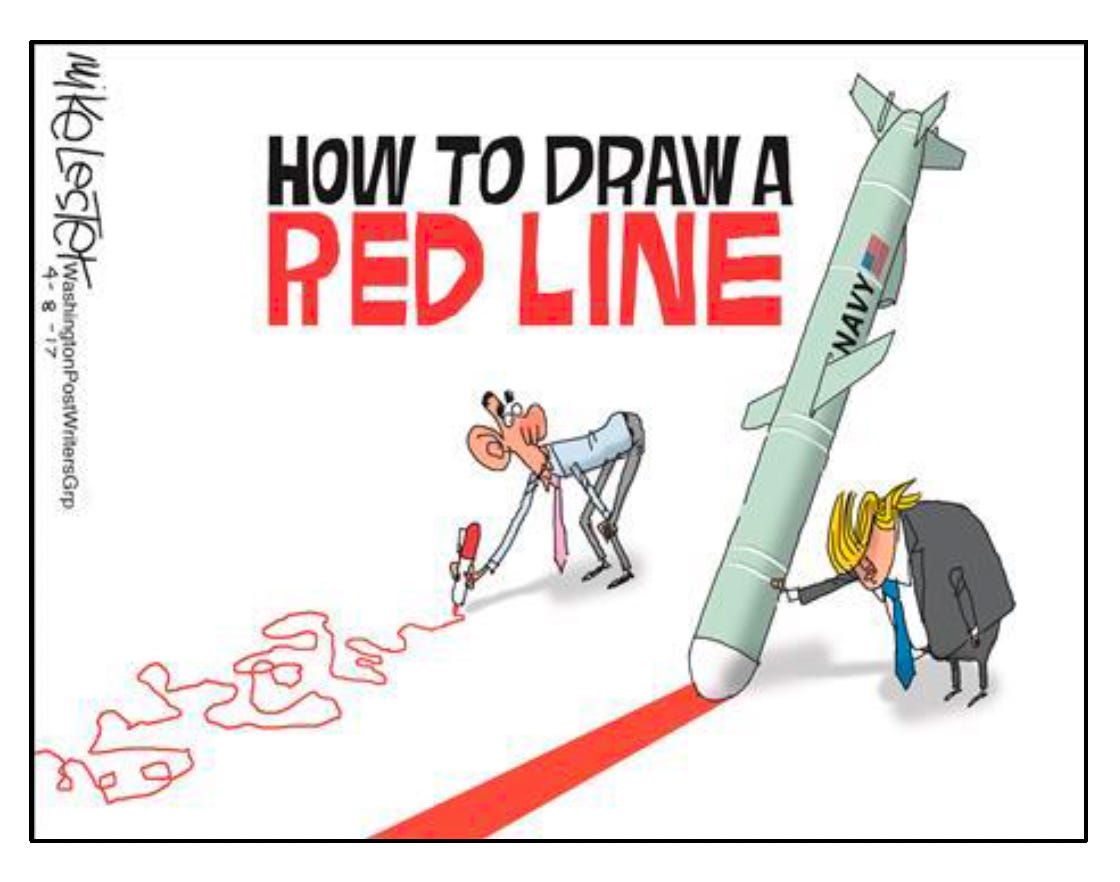
China is hardly alone in this. US President Barack Obama famously drew a red line against Syria in August 2012 when he explicitly warned the Assad regime against the use of chemical weapons on its civilian population. Yet a year later, when evidence of large-scale sarin gas attacks near Damascus was confirmed, Obama waffled on the consequences of this action and opted instead for congressional consultation, ultimately followed by acceptance of a Russian brokered standdown with Syria. The red line drawn in the sand had apparently shifted and Obama’s ultimatum backfired. It ultimately turned into a failed test of US credibility rather than a forceful tool of restraint. Notwithstanding America’s “Epic Fury” air attack on Iran, Trump’s penchant for TACO-related threats suffers from a similar credibility problem.
Like China, the United States has also stressed the multiplicity of its own set of red lines. These typically pertain to resisting foreign dominance of military enabling technologies, standing firm against coercion and security of allies, resisting nuclear threats and espionage, and ultimately, stressing the defense of democratic values. Unlike China, America’s red lines are more loosely defined and often stretched by the pressures of domestic politics. That can complicate US-China disputes with allegations of hypocrisy when the US demands red-line respect from China on an issue that it has side-stepped at home. That was certainly true at a high-level exchange in Anchorage, Alaska in early 2021, when senior Chinese officials made direct reference to America’s wave of “black lives matter” protests in response to critical comments made by then Secretary of State Antony Blinken directed at China’s human rights record.
Multiple red lines send mixed signals. They raise questions as to whether nations are going all out in an aggressive exercise of external power, or are in the grips of a contagion of national paranoia? Multiple red lines not only blur priorities, but they also make compromise on one issue, while holding firm on others, look like surrender. Claims of a profusion of existential problems can not only weaken credibility and, therefore, incentivize adversaries to call a bluff the next time a red line warning is issued but they can also raise the odds of accidental conflict escalation.
Multiple red lines essentially expand the perimeter of non-negotiability and thereby reduce the scope for diplomacy. Without effective diplomacy, leader-to-leader dialogues become all but meaningless. Focused more on threats than conflict resolution, China tends to define its redlines around sovereignty, territorial integrity, regime security, and national rejuvenation. The United States focuses more on rules, alliance credibility, deterrence, and non-coercion. As was the case in Anchorage some five years ago, these different perspectives often allow the two sides to talk past each other, potentially misinterpreting strong rhetoric as existential threats.
It is important to limit red-line inflation by narrowing the scope of this profusion of existential threats. This is complicated by an asymmetrical aspect of the problem: While the United States has increased its emphasis on threats to military applications of advanced technology, Xi’s blunt remarks at the recent Beijing summit suggest that China has now gone much further in sharpening its focus on the Taiwan red line. Nor has China conceded much ground on its other perceived existential threats. Hence, my conclusion that China has a more serious red line inflation problem than the United States.
For major central banks, inflation-control is the raison d’être of monetary policy. For a world in conflict, the imperatives of red-line inflation control take on far greater importance. Xi Jinping’s emphasis on “constructive strategic stability” as the watchword of the recent Beijing summit is at odds with China’s mounting red line inflation problem. It undercuts the aspirations of a nation that now wants to be seen as the responsible steward of a new global harmony.
I think the “red-line inflation” framework captures one real diplomatic risk: if red lines become too broad or too rhetorical, they can reduce room for crisis management and make escalation harder to control.
But I would read China’s four red lines less as inflation and more as a sovereignty architecture. Taiwan is about territorial sovereignty. China’s political system is about political sovereignty. Democracy and human rights, in the context of external pressure, are about discursive sovereignty and regime legitimacy. The right to development is about economic and technological sovereignty.
From Beijing’s perspective, these are not four separate bargaining chips. They are four layers of the same question: whether the United States accepts China as a sovereign system, or whether it still reserves the right to reshape China’s borders, political order, development path, and legitimacy narrative.
That is why Taiwan may be the most dangerous and immediate red line, but the other three are not secondary in principle. External attempts to change China’s system, weaponize human-rights discourse for geopolitical pressure, or deny China’s development rights through technological containment are also seen as unacceptable forms of interference.
The real challenge, in my view, is not that China has too many red lines. It is that the U.S. and China define sovereignty very differently. Washington often recognizes territorial sovereignty more easily than political, developmental, and discursive sovereignty. Beijing increasingly insists that stable coexistence requires all four.
True red lines aren’t stated, they are strictly revealed preferences