
A Place Holder Summit
Assessing the Trump-Xi Beijing Summit

US President Donald Trump and the CCP’s General Secretary Xi Jinping went through the motions of summitry this week in Beijing. Notwithstanding superb stagecraft of the Chinese hosts, there were no meaningful deliverables that set the long-troubled Sino-American relationship on a new course.
It was good they met and equally good that both went into the summit with the same modest expectations — achieving stability. Apart from Xi’s unmistakable warning of a potential US redline violation in Taiwan, the summit ended with a shared sense of “mission accomplished.” Post-summit spin has been predictably enthusiastic by both sides — “historic” according to Trump and a “landmark” in the words of Xi. But without deliverables, those words ring hollow.
As background for a new book that I am writing, I have reviewed the preceding 22 leader-to-leader summits between the US and China, dating back to the historic Mao Zedong-Richard Nixon meeting of 1972. Updating a taxonomy of such summitry originally developed by David Shambaugh many years ago, US-China summits can be put into six buckets: world changing, bilateral institutionalization, celebratory, place holding, crisis management, and dashed expectations (see table below). Only two summits are at the top in the “world changing” bucket — Mao-Nixon and Deng-Carter (1979) — while six fall into the bottom category, “dashed expectations,” including both Trump-Xi summits of 2017; these were glitzy gatherings — one in Mar-a-Lago and the other in Beijing — that gave the impression of celebrating a budding bromance between the two leaders but were quickly followed by the onset of the US-China trade war in 2018-19.
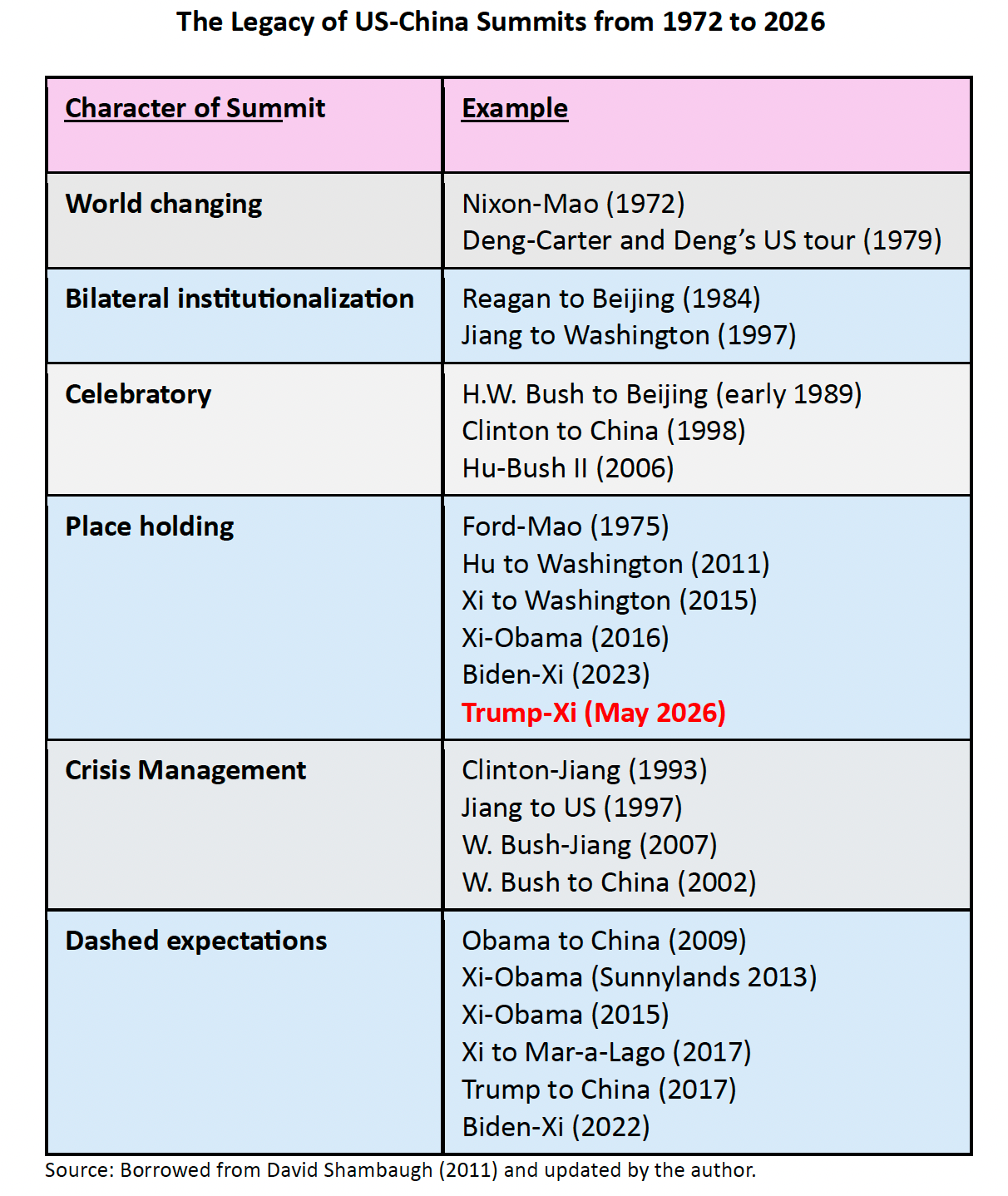
I would place the just competed summit in the “place holding” category — mid-range in terms of impact but leader-to-leader meetings that basically go through the motions of maintaining high level contact, as well as stabilizing the bilateral relationship during times of domestic uncertainty in either or both nations. This is not a bad result but is hardly worthy of the post-summit celebratory spin coming out of Beijing and Washington. It is also a tentative assessment that could improve if new deliverables are announced, or weaken, if new problems arise — including but not limited to the Taiwan problem that Xi highlighted.
Based on experience, there are always risks to a place holder summit. That is very much the case today. On the upside, are hints of a new collaborative working group on AI safety, as well as new bilateral boards of trade and investment. Having just published a piece with Max Baucus, former US ambassador to China, recommending that the US and China restart negotiations on a bilateral investment treaty, I found the possibility of a joint investment board especially intriguing — even though it would be considerably narrower by apparently focusing on non-sensitive sectors and have less room for negotiating leverage with the Chinese than a full-blown BIT.
Taiwan is the clear wildcard on the downside. It is not just that Xi Jinping uses the “red line” analogy as a hands-off warning to the United States. He has done that repeatedly in official speeches dating back to 2016. It’s that his latest reference explicitly spells out the consequences of a potential violation, as an “extremely dangerous situation” that, “if handled poorly,” could lead to “clashes and even conflicts” between the two superpowers. Donald Trump responded to this warning by, yes, handling it poorly — treating the latest $14 billion Taiwan arms proposal, following last year’s $11 billion sale, as something to be negotiated with Beijing. This is in direct violation of the third of the so-called Six Assurances of 1982, established during the Reagan Administration, which promises that “The United States would not consult with China in advance before making decisions about U.S. arms sales to Taiwan.” Ignoring this long-standing commitment, Trump stated on the return flight back to Washington that this arms agreement is, instead, a “very good negotiating chip.”
That leads me to conclude that the downside risks to my place-holder verdict on the May 14-15 Trump-Xi summit outweigh those on the upside by a considerable margin. It’s not just a misreading of Taiwan risks by President Trump that worries me. The real problem is with the US Congress, where there is broad bipartisan support for Taiwan independence, the most egregious violation imaginable of Xi’s red line. Trump has not only threatened the sanctity of the “Three Communiques and the Six Assurances” that have long anchored America’s Taiwan policy but in doing so he has opened the door for congressional interference in one of the most important tenets of US foreign policy — the “strategic ambiguity” of a One China Policy. Artfully crafted by Henry Kissinger some 45 years ago, this framework was always intended to allow for flexibility in dealing with China’s most sensitive problem. That is, until Trump — and his blatant disregard for history and strategy.
While the pundits have been quick to conclude that Xi Jinping came across as the stronger of the two leaders during the summit, I found one aspect of his performance disturbing: Once again, he tried to affix a special name to the US-China relationship and elevate it above other bilateral relationships in the world. In this summit, he dubbed it a “constructive strategic stability.” This is very reminiscent of his effort at the so-called Sunnnylands Summit of 2013, when he tried to draw US President Barack Obama into endorsing the idea of “a new model of major country relationships.” Obama came close to buying this idea from Xi, who was then in his first year of Chinese leadership. But he ultimately balked just as the US-China relationship headed downhill. It’s worth noting that the Sunnylands Summit also falls in the dashed expectations bucket in the taxonomy above, as Xi blatantly misled Obama on China’s territorial ambitions in the South China Sea.
Xi, of course, has also tried a similar approach with Russia, as China’s “partner without limits.” It’s as if he needs validation of his great-power ambitions by creating lofty images of shared global leadership. Xi even went out of his way to equate MAGA with the rejuvenation aspirations of the Chinese Dream, not the most comfortable comparison for many Americans but one that several, including yours truly, has also taken note of.
Diplomats are always relieved when a summit does no harm. That’s especially the case in a conflict-torn world like the one we live in today. In that respect, there is some sense of relief in a place holder summit. But going through the motions is hardly enough to shift the trajectory of the Sino-American relationship from conflict escalation to resolution. Maybe no harm for now — but still room for plenty of regret.
This piece tries to acknowledge how abnormal the presidency of Donald Trump is, but it fails. It tries to force the Trump-Xi meeting into the summit template where nations meet to manage their policy differences, when the real question is how much of this is still happening? The president evidences greatly diminished capacity to understand even basic aspects of US policy and has zero desire to participate in a policy conversation. When he does encounter a stated US policy he deliberately contradicts it, hoping to turn it into an opportunity for extortion. And his true concerns revolve around getting Xi to acknowledge his greatness and negotiating corrupt private deals for his family and the billionaires he brought with him. In this environment, I think we have to understand that any reports on of the 'summit' by US officials are primarily damage control efforts that pretend to policy discussions that never took place. Calling this a 'place holder' meeting is thus very much upselling the idea that Trump and Xi sat down to discuss matters of national policy and not Trump's obsessions and personal financial interests. Both leaders got their finely choreographed photo opportunity and that seems to have been their primary focus and the only thing they agreed on.
Great piece!
I think Dr. Roach’s “place holder summit” framing is a very useful corrective to the celebratory language from both sides. This was not a historic breakthrough, and it did not resolve the structural contradictions in U.S.-China relations. His caution on the lack of major deliverables and the downside risks around Taiwan is well taken.
My only addition would be that a “place holder summit” may have more significance in the current phase of world order than it first appears.
My own way of looking at this is that the G2 world has arrived, but the G2 order has not. The United States and China now sit at the center of many of the world’s most dangerous questions, including Taiwan, AI, tariffs, rare earths, investment, military signaling, and crisis management. But there is no stable G2 governance mechanism, no shared rulebook, and no real joint management of the world.
In that context, place holding is not necessarily empty. For a G2 world without a G2 order, communication, boundary-setting, de-escalation, and expectation management may themselves be part of the early search for a new operating framework.